LuxuryCarMagazine En Luxury Car Review and News
Wellington, ON — In an effort to continue to lengthen the reach of Cadillac’s ATS compact luxury sedan, The General’s luxury arm has shaved off two doors, added some track width (and mighty fine fender flares to accommodate that) and released the ATS Coupe for the 2015 model year.

Review Overview
Styling - 85%
Driving Pleasure - 85%
Performance - 75%
Driving Comfort - 80%
Interior Space - 65%
Fuel Economy - 75%
Winter - 75%
77%
It does look good; especially from directly behind it, the angle from which to best appreciate the now 20 millimeter wider track width (the 2,775 millimeter wheelbase and 4,663 mm overall length remain the same as the sedan, however). To add even more athleticism to the profile, the roofline has been chopped by an inch, and the trunk-mounted (yes, it still has a trunk) taillight has been moved lower on the rear fascia, to make it look like the Coupe rides lower than the sedan (which it doesn’t). Those fender flares, especially at the rear, are delicious as well. As are the massive dual exhaust pipes.
In profile, the ATS isn’t quite as much a departure from its sedan cousin as the CTS (even less so from the front, save slightly wider fenders and an all-new Cadillac emblem on the grille) when it lost two doors, and it’s not quite as brash as the ELR. Indeed, it’s a little more laid back in profile, providing a bit more of a grand touring vibe.
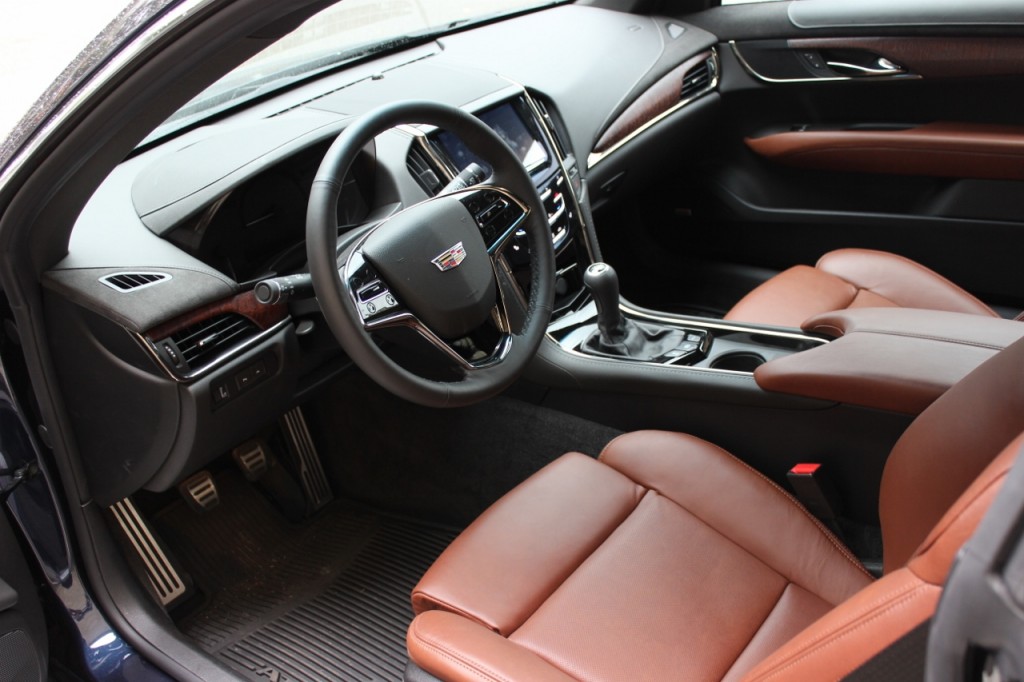
Inside, the ATS Coupe benefits from a newfound emphasis from Cadillac on upping the ante with regards to the materials used, the placement of the controls and the technology on-hand.
Sure, Caddies have always done the rich leather, nice wood thing rather well, but it’s taken up to “11” here.
For starters, if you see something that looks like it’s crafted from metal, it is. That goes for the standard shift paddles, the door pulls and door trim. If you see a wood insert, then it’s real wood, either of the open-pore or lacquered variety. The carbon fibre? Real, and finished in a nice red/back weave to match the Morello Red leather interior. Alas, you can’t mix-and-match; the only way to get the carbon fibre is with the red seats. Which is OK, because the two flashy elements compliment each other well. The seats are nice and supportive, too.
The Alcantara suede inserts on the doors are another nice element that you wouldn’t expect to see on an entry-level car (which the ATS is, in the Cadillac universe, anyway) and it adds some real sporting attitude that is in keeping with Cadillac’s plans on appealing to younger buyers for whom fancy wood and leather isn’t enough; they want some flash, some panache to go with their car.
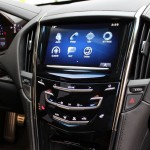
On the infotainment front, it’s all Cadillac CUE (Cadillac User Experience), all the time. Available on base trims and standard on the three trims above base, everything is activated via either a touch screen (good) or a touch pad (not as good). You slide your finger along a silvery bar for volume control, you tap a picture of a seat to adjust your seat warmers (there is no seat cooler option) and so forth.
It works, for the most part, with the touchpad—which runs the length of the lower centre stack—providing haptic feedback when a command is processed.
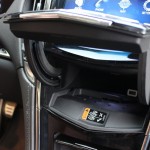
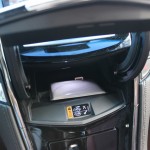
Trouble is, that’s often not strong enough, so you’re unsure if the command has been received or not and the shiny, piano-black finish attracts dust like your dryer’s lint guard, making it look positively filthy if the sun hits it the right way. Changing the piano-black finish to something less reflective—a matte finish, perhaps—would go a long way to correct this issue. It does flip forward to provide a secure storage cubby, though. Once you figure out how to activate it (you tap the base of the stack slightly upwards).
Connectivity-wise, you get your Bluetooth (obvs) but for the first time in a Caddy, you can get a WiFi hotspot and data plan (free for three months, $15 thereafter). Up to seven devices can be attached at once, so the whole family can do their own thing. I’m still a little unsure of how many are willing to spend money for a data plan in addition to what’s on their phone, but Caddy thinks the young ‘uns like tech, so there you go.
Where I see definite value, however, is in the ability for the car to now read you your text and allow you to voice them back. We did have a little trouble getting this to work, however; you have to be sure to turn off your car once you pair your device for it to be recognized. Strange, and likely fixable with a software update.
Luckily, while the haptic feedback from the touch pad may not be completely up to snuff, the steering feel is remarkably good.
Yes, it’s an electronic set-up and yes, there’s some artificiality there but it remains one of the nicer surprises I’ve recently felt in this segment. Even the BMW M4 with its M-button and modifiable steering settings can learn something from the ATS.
It’s funny that a modern BMW jumps to mind, because the ATS actually brings to mind the fantastic, hydraulic-assist set-ups from Bimmers of old. That, dear readers, is by no means a bad thing; to have a steering rack this day in age that’s as precise as the ATS’ is, is an absolute blessing for enthusiasts.
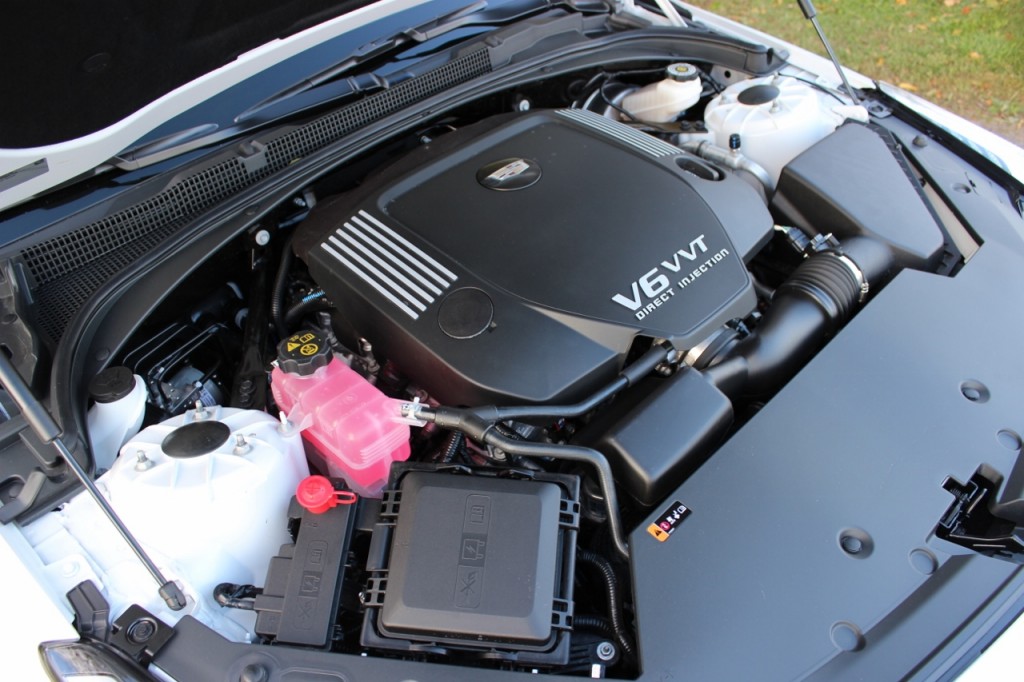
If you want some more German-ness from your ATS (well, aside from its being developed at the Nurburgring), you can turn to the exhaust note, of the V6 in particular. It’s just a little metallic, just a little muscle car like and all the way nice. It does a great job of conveying the 321 horsepower and 275 lb.-ft. of torque under the hood. 2.0L turbo models, meanwhile, get 272 hp and 295 lb.-ft.; that’s the highest amount of torque available from a four-banger in the segment, beating out the likes of the BMW 428i and Mercedes-Benz C300.
As good as the V6 sounds, it’s the turbo four that really impresses. Peak torque is reached at 3,000 r.p.m. and keeps pulling to 4,600; there’s quick forward progress, sometimes unexpectedly so.
It becomes a little easier to stay in the meat of the powerband if you select the six-speed manual transmission, which you can have on all four available trims ($41,240 Standard, $46,285 Luxury, $48,395 Performance and $51,436 Premium), as long as you’re OK with having RWD; automatic-only for AWD models. You do get a limited-slip differential for RWD cars, though; you can even induce a little rear-end slip if you really get on it.
In addition to the steering, optional magnetic ride dampers and a five-link rear suspension set-up help provide a car that handles remarkably well; it’s also lighter than the competition from Audi, BMW and Mercedes thanks to a focus on high-tensile steel and aluminum for the body and chassis.
Of course, this being Canada the AWD versions are likely going to be the big sellers—it’s a simple matter of necessity—but if you really want the sportiest of the cars, then you gotta go with the lighter RWD models. Preferably with a manual transmission.
The real question is whether or not Cadillac is going to be able to crack that young professional demographic; it’s a group that has flocked to the Germans and Japanese for quite some time now, and there’s a lot of momentum associated with that.
With the ATS, however, the price is right, the engineering’s there and there’s something to be said for a car that’s been tasked with spearheading a bit of a revolution for GM’s luxury brand.