LuxuryCarMagazine En Luxury Car Review and News
On the surface, the Lexus RC F looks to be a surefire competitor to the BMW M4, or perhaps even the Porsche Cayman S.

Review Overview
Styling - 80%
Driving Pleasure - 70%
Performance - 85%
Driving Comfort - 80%
Interior Space - 75%
Fuel Economy - 65%
Winter - 60%
74%
However, spend a little more time with Lexus’ hi-po coupe, and some similarities from those two cars do emerge, yes, but not as entirely as you may think.
First of all, the basics.
The “F” in RC F stands for “Fuji”, as in Japan’s Fuji speedway, where Lexus has a dedicated testing facility and where the RC F was developed. So from that angle, it has the performance creds.
The powertrain is a similar story; that’s a 457 horsepower 5.0-litre V8 under the hood that also pushes out 389 lb.-ft. of torque, available at 4,800 r.p.m. All that power is fed to the rear wheels via an eight-speed automatic transmission and a Torsen limited slip differential as standard, with an optional electronic differential, or “Torque Vectoring Differential (TVD)” in Lexus-speak. Out tester was fitted with the latter, which we’d soon find out was both a blessing and a curse.
The engine is a monster, though, both in the power and physical sense. Physically, the V8 sits higher than does the V6 from the RC 350 on which the F is based, necessitating a hood bulge similar to that of the M4. It looks spectacular, and it’s one of the few styling touches that differentiates it from the RC 350, along with the blacked-out spindle grille, wheels, and optional carbon fibre roof and active rear spoiler. It looks the business, that’s for sure, especially in the oh-so-Lexus-F Ultrasonic Blue Mica colour. Incidentally, the headers are painted to match, doing away with the annoying luxury-car habit of shrouding the entire engine bay in boring black plastic.
Inside, the blue theme continues, with blue stitching on the shift knob and gauge cluster hood, which are both finished in Alcantara suede. There’s also a blue tint to the leather on the seats, but it’s a little harder to spot, depending on lighting. The seats, meanwhile, are heavily-bolstered sport items, that even have portholes built into the headrest should you ever want to fit a racing harness. Which is probably unlikely, but they do look the business.
On the tech front, the RC F gets Lexus’ mouse pad-like infotainment system, which is an interesting take if one that is not really any better than the scroll wheel seen on so many other systems. It does reduce cluster on the centre console, though, which is nice because the rest of the cabin is a chaotic convergence of angles, materials and features. What I will say, however, is that there’s no piano black finish, which is nice because it gets greasy and dusty like no other. Instead, we have real carbon fibre accents.
The seats, meanwhile, are comfortable and Lexus has done a good job of making occupants feel properly ensconced in the cabin, even though the RC F is not a small car.
The gauge cluster is an all-digital affair, whose gauges change depending on which of the four drive modes you selected. The way they flash and dance as you rev, meanwhile, is very LFA supercar. There’s an ECO mode, yes, but I would be surprised if that many people use it. That being said, it and Normal are the only two modes that stay active once you switch off the ignition; if you’ve switched off while in Sport or Sport +, it will always revert back to Normal once you prod the starter button next time.
When you do, you’re treated with a proper V8 bellow as the revs flare a little; the sound is pretty far away from what you’d expect from a Lexus of any type, and if sound was all we were to go by, then the RC F means business.
This being a naturally-aspirated powerplant, power comes on smoothly, even if you do have to be patient as the revs climb, the exhaust baffles open, and the full slug of power is delivered. When it does come, though, you need to be prepared as the forward progress becomes just short of manic.
It’s helped along by the excellent paddle shifters, which are snappy in their movement and whose commands are answered in short order by the transmission. When you’re on the straight and narrow, this is a car that feels impeccably sorted; 100 km/h only takes about 4.5 seconds from rest to achieve.
Once you’re off the straights, however, the experience changes a little bit.
You see, and almost 4,000 lbs., the RC F is by no means a lightweight and as you start to toss it from apex to apex, the chassis has a little bit of trouble keeping up with the powertrain. Yes, the TVD system helps—it’s adjustable three ways in addition to the drive modes, so there are many possibilities with the RC F—but none of them really gave me that left-right-left snappiness I’d hoped for from a car that’s been developed on the race track (and indeed, has a racing variant that competes in the Japanese Touring Car Championship).
Plus, since there’s no way to completely deactivate the traction control system, no matter which TVD/drive mode you’re in, you’re never going to be able to really get the rear end sliding and so forth. You’d have to think that perhaps the basic Torsen mechanical LSD would be the better option, if a more engaging drive is what you’re after.
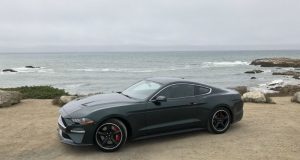
As it stands right now, however, the RC F actually reminded me a little less like a BMW M4 and more of a certain other coupe powered by a 5.0L V8, and that’s the Ford Mustang GT. Granted, that car’s handling package has improved with this latest generation, but it sure as heck doesn’t cost you over 90 grand to get one, as does our RC F tester.
Having said that, there’s little doubt that there’s a tonne of strong engineering here, and that powertrain is other-worldly, and I love it. If they can find a way to lighten the load a little, and make that rear end a little more playful, then the M4, Audi RS5 and even the Cayman would have something to think about.